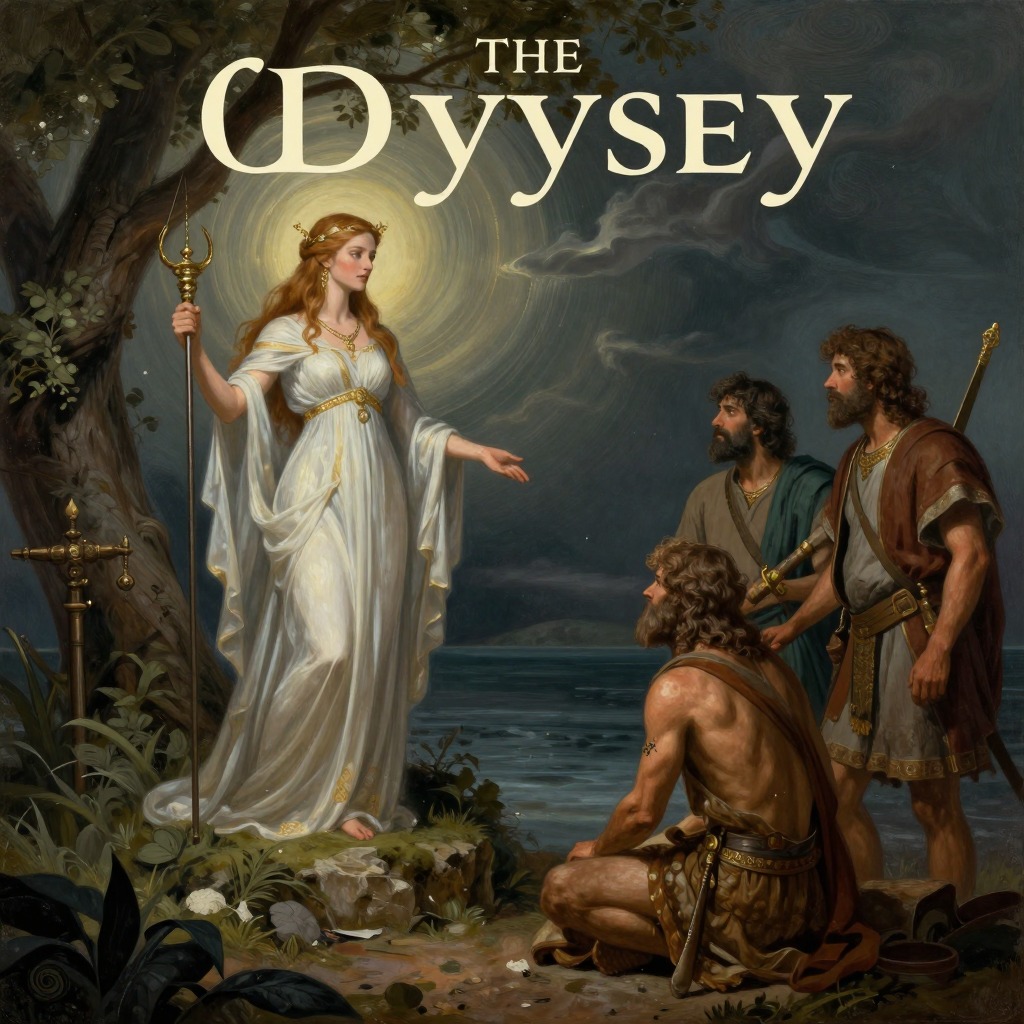
Tantalus
Tantalus appears only briefly in the Odyssey, but his presence in the catalogue of the damned that Odysseus witnesses during the Nekyia gives the poem one of its most enduring images of punishment. He is not a character who acts within the story's own time; he belongs to the pre-Trojan-War generation of heroes whose fates serve as moral exempla for Odysseus's own journey. His single appearance, in Book 11, is a tableau of frustration: he stands in a lake that reaches his chin, dying to quench his thirst, yet whenever he stoops to drink the water dries up and vanishes, leaving nothing but parched ground. Above his head hang tall trees laden with pears, pomegranates, apples, sweet figs, and juicy olives, but whenever he stretches out his hand to take them the wind tosses the branches back to the clouds. The punishment is a perfect physical metaphor for the condition of penia—need that can never be satisfied—and it is presented without narrative comment, as one item in a series of exemplary sufferers that also includes Tityus and Sisyphus.
Crime and Transgression
The text does not state Tantalus's offense within the Odyssey itself, but the context of the other punished figures makes the nature of his transgression clear. Tityus is being tortured for having violated Leto, Zeus's mistress; Sisyphus cheated death through trickery. Tantalus's crime, known from the broader mythological tradition that the poem assumes its audience knows, was a violation of the fundamental boundary between gods and mortals: he had been admitted to the table of the gods but betrayed that privilege—either by stealing nectar and ambrosia, by revealing divine secrets to humans, or, in the most famous version, by killing his own son Pelops and serving him to the gods to test their omniscience. The punishment that Odysseus sees is thus the consequence of hubris directed specifically against the Olympian order, a crime of overstepping the mortal station. The lake and the fruit tree are not arbitrary torments; they mirror the abundance from which Tantalus was banished, making the deprivation a precise inversion of the hospitality he abused.
Narrative Function and Thematic Significance
Tantalus's place in the Nekyia is structural as well as moral. He appears after the parade of famous women and before the encounter with the ghost of Hercules, in a sequence that moves from the genealogical past to the heroic past and finally to the figures of eternal punishment. This ordering gives Odysseus—and the reader—a graduated vision of the afterlife: first the neutral realm of shades, then the special torments reserved for those who committed offenses against the gods themselves. For Odysseus, who is himself navigating a world of divine anger and propitiation, the sight of Tantalus serves as a reminder that the gods' memory is long and that privileges extended to mortals can be revoked with terrible finality. The image also resonates with Odysseus's own situation: he too has been offered immortality by Calypso and has refused it, choosing instead the mortal condition of hunger, thirst, and longing. Tantalus is what happens when that longing is not merely accepted but punished—when desire becomes an eternal, unfulfillable present. The episode thus reinforces one of the poem's central ethical lessons: that the proper response to the gods' gifts is not to grasp for more than one's share, but to accept what is given and to return home.